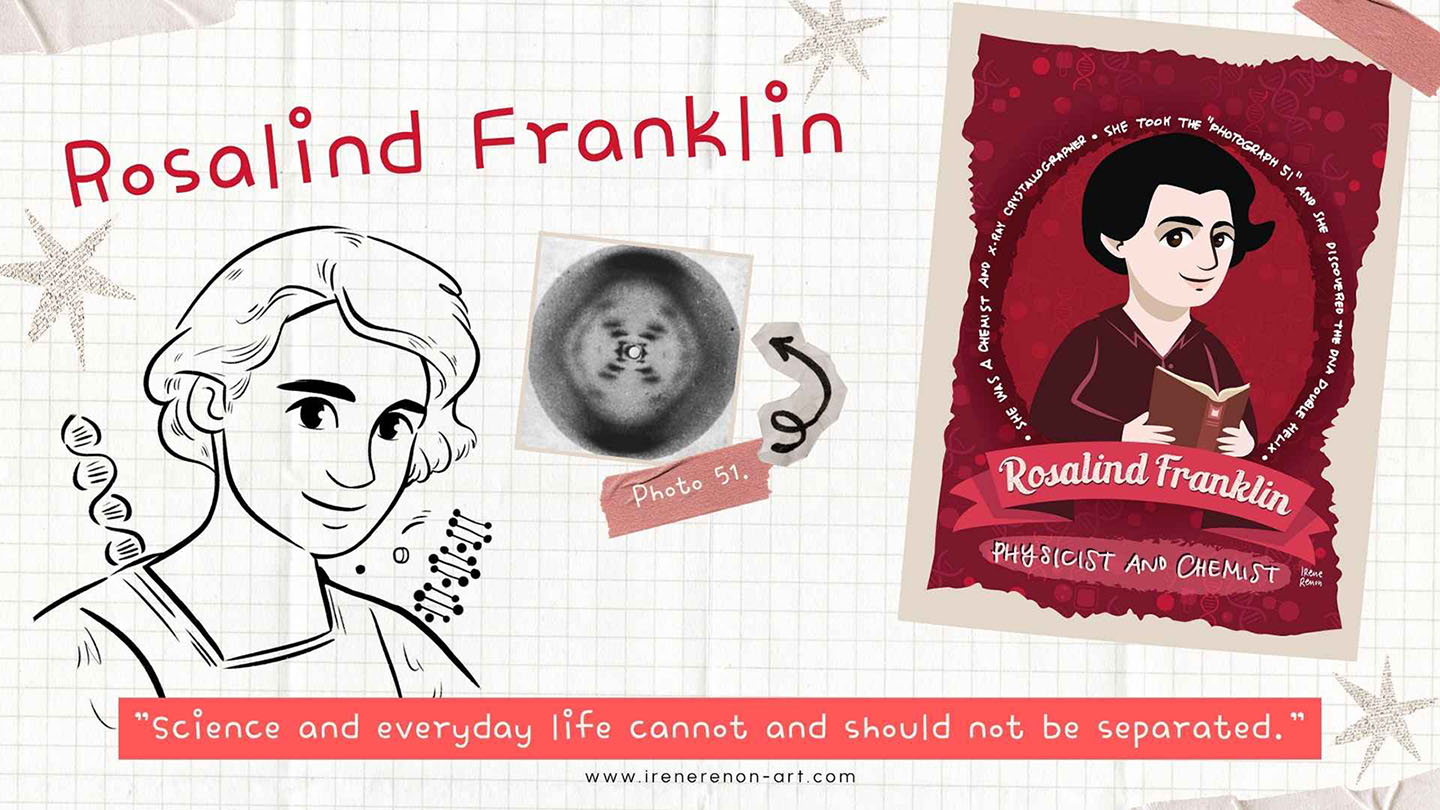
Rosalind Elsie Franklin (Kensington, July 25, 1920 – London, April 16, 1958) was a chemist and an X-ray crystallographer. She is best remembered for her contribution to the study of the molecular structure of DNA, RNA, some plant viruses, coal, and graphite.
Rosalind Franklin’s work on X-ray diffraction images of DNA contributed to the discovery of the DNA double helix.
When I grow up, I’ll be a scientist
Rosalind was born in London in 1920 into a wealthy Jewish family. From an early age, she showed a brilliant mind and a natural aptitude for science, so her parents enrolled her at the prestigious St. Paul’s Girls’ School. Later, against her father’s wishes, Rosalind enrolled in Chemistry and Physics at the University of Cambridge, where she graduated with a thesis on the structural characteristics of coal molecules. After the end of World War II, she moved to Paris to study X-ray diffraction, a technique used to investigate crystalline solids.
Rosalind proved to be exceptionally talented at this work, and for this reason she was invited to join the Biophysics Laboratory at King’s College London, where researchers had begun studying DNA. Rosalind Franklin was only 30 years old at the time, with an extraordinary scientific potential.
Can you say deoxyribonucleic acid three times in a row?
At the time, very little was known about DNA, its structure, or how genes were transmitted. This is why Rosalind Franklin’s research was so important: it provided experimental evidence about the structure of DNA. Okay, but how? With an image—or rather, a photograph.
DNA, or deoxyribonucleic acid (remember how funny it was to repeat that during science exams? :)), contains our genetic information, which is necessary for the biosynthesis of RNA and proteins (the molecules that allow all living things to develop), and is essentially the key to life.
What we are is written in these two loooong strands that run through our cells in opposite directions, never meeting each other. The discovery of the structure of DNA made it possible to understand how genetic information is passed from parents to their children. Megawow.
I’ll take a picture of you, quote
By now you may be wondering: surely such a revolutionary discovery must have earned her at least some recognition, right? And yet… the credit for this great discovery did not come to Rosalind Franklin, at least not during her lifetime. In fact, her colleagues James Watson, Francis Crick, and Maurice Wilkins received the 1962 Nobel Prize in Physiology or Medicine. Instead of her. Thanks to the results of her research.
The three scientists built the double-helix model using the famous “Photo 51”, the image I mentioned a few lines above. The DNA photograph was obtained by Rosalind Franklin using X-ray diffraction.
Photo 51 was taken from Franklin’s laboratory and shared with Wilkins and Watson without her knowledge. But that’s not all: Rosalind Franklin’s contribution was never mentioned, not even during the 1962 Nobel Prize ceremony.
Adding insult to injury
A few years later, in his book The Double Helix, Watson described the incident and treated it in a rather joking manner, while continuing to downplay Franklin’s contribution to the discovery of DNA’s structure.
The feminist movement and one of Rosalind’s friends, Anne Sayre, fought to ensure that her contribution to this extraordinary discovery was finally recognized. Unfortunately, Rosalind died in 1958, four years before the Nobel Prize was awarded, and the prize could only be given to living scientists.
Rosalind Franklin died at just 37 years old from ovarian cancer (which is sometimes suggested to have been caused by her frequent exposure to X-rays).
Her revolutionary research allowed scientists around the world to deepen their understanding of who we are and of the genetic heritage we carry with us from generation to generation.
James D. Watson and Rosalind Franklin
The environment at King’s College proved hostile to Rosalind, who immediately faced the dismissive attitude of her male colleagues. Maurice Wilkins, in particular, did not appreciate her completely independent and unconventional way of working.
Here are some passages from James D. Watson’s book The Double Helix:
[…] But most of our conversation centered on the subject of Rosalind Franklin. The girl was causing more trouble than ever. Now she insisted that Maurice should no longer take DNA photographs with X-rays. […] Things had reached the point where Rosy would not even communicate her latest results to Maurice. To find out where things stood, he had to wait another three weeks, when Rosy would give a seminar on her work of the previous months.
James D. Watson, The Double Helix: A Personal Account of the Discovery of the Structure of DNA, Milan, Garzanti, 2004, p. 75.
It seems that Watson was more interested in Rosalind Franklin’s physical appearance and personality than in her work:
Rosy spoke before an audience of about fifteen people, in a rapid, clipped language that suited the old, bare lecture room in which we were gathered. There was no warmth or liveliness in her words. Yet she had a certain vague charm. For a moment I found myself wondering what she would look like without glasses and with a different hairstyle. […] Years of careful and dry crystallographic research had left their mark on her. […] Then the discussion ground to a halt, and it was clear from the faces of the audience that either they had nothing to say or they felt it was in poor taste to keep repeating themselves. Perhaps they were reluctant […] to mention models for fear of receiving a sharp reply from Rosy. And besides, it was not pleasant to be told by a woman, as they faced that gray, foggy November evening, that it was unscientific to make judgments about subjects in which one did not have sufficient expertise. It was the best way to bring back some unpleasant memories of schooldays.
James D. Watson, The Double Helix: A Personal Account of the Discovery of the Structure of DNA, Milan, Garzanti, 2004, pp. 83–84.
It is difficult, if not impossible, to deny Watson’s aversion and misogyny toward Franklin. Personally, I wish things had been settled between them like this (see the little drawing below).
To learn more:
- A biography by Brenda Maddox about Rosalind Franklin’s life and work. The book I linked is in English, but it is also available in Italian under the title Rosalind Franklin, la donna che scoprì la struttura del DNA.
- A short documentary in English about the discovery of DNA and Rosalind Franklin’s story. The music is appropriately creepy, but the film itself isn’t bad. XD
- A short comic about Rosalind Franklin, drawn by Kate Beaton, highlighting the difficulty of finding one’s place in a predominantly male—and sexist—environment such as King’s College in the 1950s and ’60s.
If Rosalind Franklin’s story inspired you, you can find my illustrations and educational prints celebrating her life and contribution to science in my shop. Take a look!
Speak soon,
Irene
